Book Categories:










Wait, don't go!
Before you leave, we have a special offer just for you!
Get 20% off your next purchase.
Before you leave, we have a special offer just for you!
Get 20% off your next purchase.
This article explores what compressed air is, how it is created, why it is so useful, and how entire systems are built around it to deliver reliable performance.
Compressed air is one of the most widely used yet least understood forms of energy in the world. From powering tools on a factory floor to inflating bicycle tires, compressed air is deeply integrated into countless applications—both industrial and everyday. Although invisible and often taken for granted, it plays a crucial role in modern manufacturing, construction, transportation, and even entertainment. This article explores what compressed air is, how it is created, why it is so useful, and how entire systems are built around it to deliver reliable performance.

Contents
At its core, compressed air is simply atmospheric air that has been pressurized to a higher level than the surrounding environment. Air itself is a mixture of gases, primarily nitrogen (about 78%) and oxygen (about 21%), with trace amounts of other gases such as argon and carbon dioxide. When this mixture is compressed, its molecules are forced closer together into a smaller space. This increases both the air’s pressure and its stored energy.
When air is compressed, the temperature also rises. This increase in temperature is known as the heat of compression, a physical phenomenon that occurs because the molecules move more rapidly when they are forced into a smaller volume. The energy required to compress the air is stored within it and can be released later to do useful work.
A simple analogy helps illustrate this concept: imagine inflating a balloon. As you blow air into the balloon, you are compressing the air inside. The balloon expands, and energy is stored in the pressurized air. When you let go of the balloon’s opening, that stored energy is released, and the balloon shoots away. This is the same basic principle that governs industrial air compressors.
Compressed air is so useful because it is a highly versatile and relatively safe medium for storing and transmitting energy. Unlike electricity, compressed air does not pose a risk of electrical shock, and it can be used in environments where electricity would be dangerous—such as wet or humid conditions. In addition, pneumatic tools powered by compressed air are often lighter, simpler, and more durable than their electric counterparts.
For example, in construction sites or mining operations where rugged conditions and moisture are common, pneumatic tools like jackhammers, drills, and impact wrenches are often preferred because they are less susceptible to damage from the environment. Compressed air systems also offer variable speed and torque control, which makes them highly adaptable to different tasks.
Another key advantage of compressed air is safety. In applications where electrical sparks could ignite flammable gases or dust, compressed air tools provide a much safer alternative. Because they operate without electrical power at the point of use, they significantly reduce the risk of fire or explosion.
Despite its many advantages, compressed air is not always the most energy-efficient solution. The cost of producing compressed air can be several times higher than that of generating electricity. However, the simplicity, reliability, and durability of pneumatic systems often make them more cost-effective in demanding industrial environments where downtime and equipment failure are costly.
Because of its ubiquitous use in manufacturing, processing, and utilities, compressed air is sometimes referred to as the “fourth utility” alongside water, electricity, and gas. Many factories and industrial facilities treat compressed air as a fundamental utility that must be available at all times.

The process of creating compressed air begins with an air compressor, the central component of any compressed air system. An air compressor draws in ambient air, pressurizes it, and delivers it to storage or directly to tools and machinery.
There are several different types of air compressors, but all of them work on the same basic principle: they reduce the volume of air, thereby increasing its pressure. The most common types include:
Regardless of the type, all compressors must manage the heat generated during compression. Many systems include aftercoolers and heat exchangers to remove excess heat, improve efficiency, and protect downstream components.
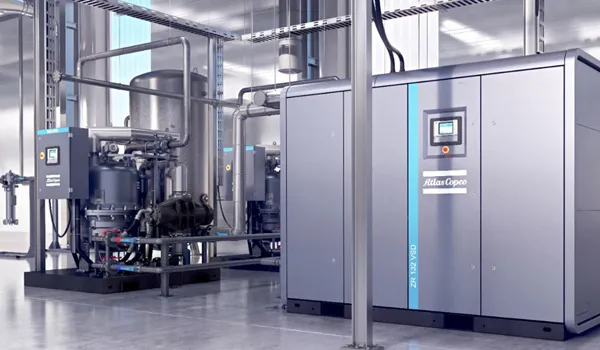
A complete compressed air system includes more than just the compressor itself. To ensure efficient, reliable, and high-quality air delivery, several additional components are typically incorporated:
Air Receiver Tank:
This is a storage vessel that holds compressed air and helps balance the supply and demand within the system. It also reduces pressure fluctuations and improves overall efficiency.
Air Dryer:
As air is compressed, moisture naturally condenses out of the gas. Without proper drying, this moisture can lead to corrosion, contamination, and damage to tools and machinery. Air dryers remove excess water vapor and help maintain air quality.
Filters:
Filters remove particulates, oil, and other contaminants from compressed air. Clean air not only protects equipment but also improves product quality in sensitive applications.
Piping and Distribution:
High-quality piping is essential to deliver compressed air throughout a facility without significant pressure losses. Materials such as aluminum and stainless steel are often used to minimize leaks and maintain system integrity.
Chillers:
In systems where heat is a concern, industrial chillers may be used to cool compressed air and associated equipment. This helps prevent overheating and maintains stable operating temperatures.
Together, these components form a complete compressed air system that delivers clean, dry, and reliable air to wherever it is needed.
The range of applications for compressed air is vast and continually growing. In industrial settings, compressed air powers pneumatic tools, controls automation systems, operates valves and actuators, and drives material handling equipment. In the automotive industry, it is used for painting, assembly, and tire inflation. In food and beverage production, compressed air is used for packaging, bottling, and cleaning.
Even outside of manufacturing, compressed air plays important roles. In hospitals, it is used for respiratory equipment and laboratory instruments. In construction, it powers jackhammers and concrete breakers. In agriculture, it is used for crop spraying and equipment cleaning. From powering everyday tools to enabling complex industrial processes, compressed air is indispensable.
Like any engineered system, compressed air systems require regular maintenance to operate efficiently and avoid costly downtime. Some essential maintenance practices include:
Compressed air may be invisible, but its impact on modern life and industry is immense. It is a flexible, powerful, and safe form of energy that supports a vast array of applications, from powering heavy industrial tools to supporting delicate manufacturing processes. By understanding how compressed air works, how it is produced, and how systems are designed and maintained, engineers and operators can maximize efficiency, reduce costs, and ensure reliable performance.
Although compressed air systems require careful planning and maintenance, their benefits—versatility, safety, and durability—make them a cornerstone of industrial infrastructure around the world.
The right system protects equipment, prevents downtime, and ensures clean, reliable production, which is saving you money over time. We are here to find you the best dryer for your application.