Book Categories:










Wait, don't go!
Before you leave, we have a special offer just for you!
Get 20% off your next purchase.
Before you leave, we have a special offer just for you!
Get 20% off your next purchase.
This guide provides a comprehensive, restructured explanation of air compressor types, based on the core principles and classifications outlined by Atlas Copco, while expanding the insights into a practical and easy-to-understand framework.
Air compressors are essential across modern industry, powering everything from manufacturing lines to medical systems and food processing. Despite their widespread use, many users still struggle to understand the different types of compressors and how to select the right one. Choosing incorrectly can lead to inefficiency, higher costs, and operational limitations.
This guide provides a comprehensive, restructured explanation of air compressor types, based on the core principles and classifications outlined by Atlas Copco, while expanding the insights into a practical and easy-to-understand framework.
Contents
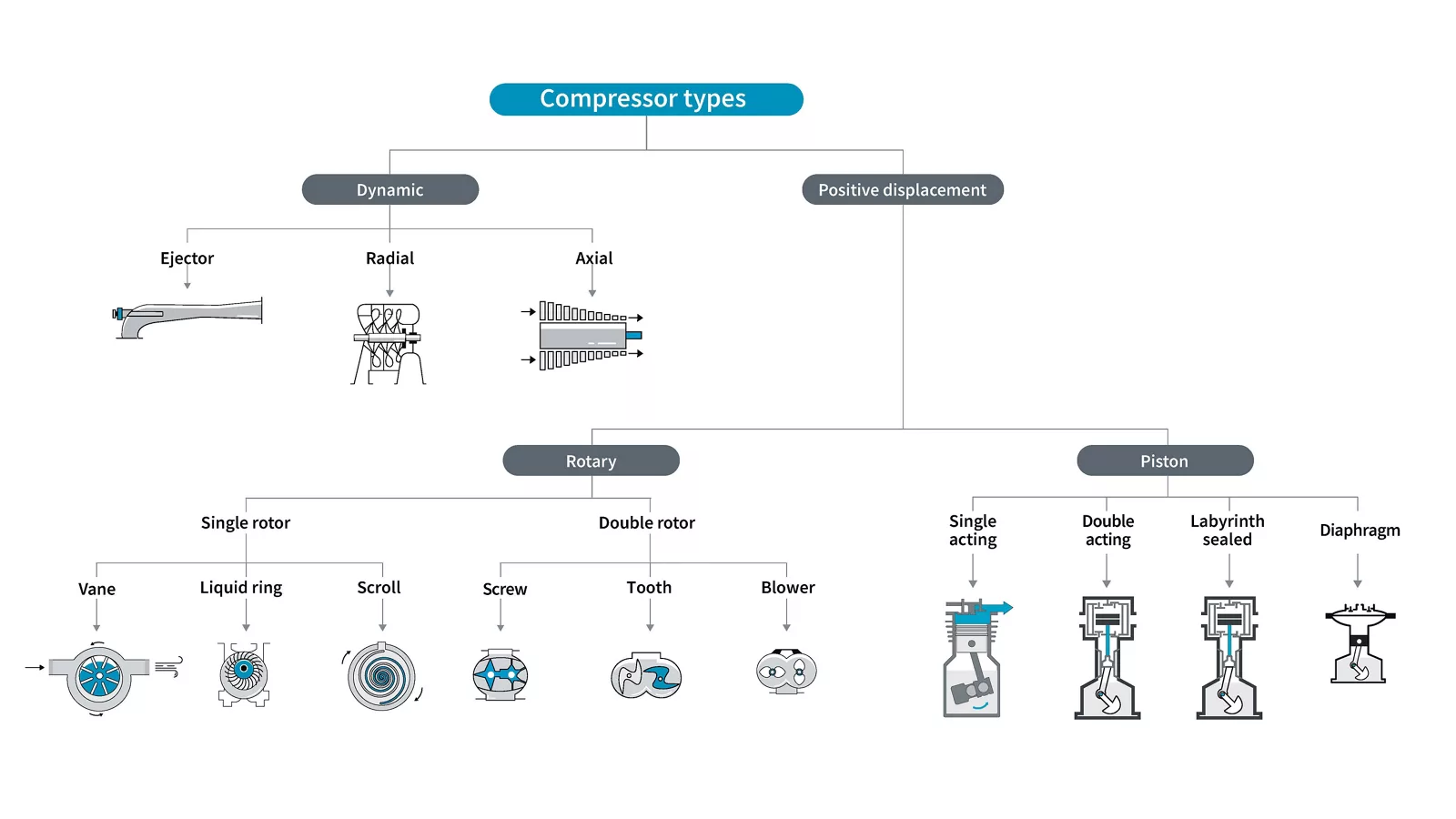
All air compressors, regardless of size or application, are built on two fundamental compression principles: positive displacement and dynamic compression.
Understanding these two categories is critical because every compressor type you encounter is derived from one of them.
Positive displacement compressors work by physically reducing the volume of air within a closed chamber. As the volume decreases, the pressure increases—this process follows a basic physical law stating that pressure and volume are inversely related.
This method delivers compressed air in controlled quantities and is widely used in industrial and workshop environments.
Dynamic compressors, on the other hand, operate by accelerating air to high velocity and then converting that velocity into pressure. Instead of trapping air, they rely on motion and energy transfer to achieve compression.
These compressors are typically used in applications requiring large volumes of air.
From these two principles emerge four primary compressor types used in industry:
Each type has distinct working mechanisms, advantages, and ideal use cases.

Piston compressors are one of the oldest and most widely recognized compressor types. They use a crankshaft-driven piston to draw air into a cylinder and compress it by reducing the internal volume.
Air enters a chamber when the piston moves downward. As the piston moves upward, the chamber volume decreases, compressing the air and forcing it out at high pressure.
Piston compressors are known for their affordability, simplicity, and ease of maintenance. They are particularly suitable for intermittent use and smaller operations.
These compressors are commonly used in:
While cost-effective, piston compressors are not ideal for continuous operation. They tend to generate more noise and require more maintenance compared to modern alternatives.

Rotary compressors represent a more advanced form of positive displacement technology. Instead of pistons, they use rotating elements such as screws, vanes, or lobes to compress air.
Air is drawn into a chamber and trapped between rotating components. As these components move, the available volume decreases, increasing air pressure before discharge.
Rotary compressors are designed for continuous operation and offer several benefits:
They are especially valued in industrial environments where downtime is costly.
Although the initial cost is higher than piston compressors, rotary systems often provide better total cost of ownership due to energy efficiency and durability.

Centrifugal compressors belong to the dynamic compression category and are designed for applications requiring large volumes of compressed air.
Air enters the compressor and is accelerated by a rapidly rotating impeller. The air is then directed outward (radially), increasing its velocity. This kinetic energy is converted into pressure in a diffuser section.
Compared to axial compressors, centrifugal models can achieve higher pressure but typically deliver lower flow rates.
These compressors require significant investment and are best suited for operations with stable, high-demand air requirements.

Axial flow compressors are another type of dynamic compressor, often associated with highly specialized industries.
Air flows parallel to the shaft and passes through multiple rows of rotating blades. Each stage gradually increases the air pressure.
Axial compressors can deliver higher flow rates than centrifugal compressors but generally operate at lower pressures.
Due to their complexity and cost, axial compressors are rarely used in standard industrial facilities.
Each compressor type serves a different purpose, and no single option is universally “best.” Instead, the right choice depends on your specific operational requirements.
Dynamic compressors (centrifugal and axial) are ideal for high flow applications, while positive displacement compressors (piston and rotary) are better suited for higher pressure and controlled output.
Piston compressors are ideal for intermittent tasks, whereas rotary compressors excel in continuous operation environments.
Lower upfront cost often comes with higher long-term operating expenses. Investing in efficient technology, such as rotary compressors, can significantly reduce energy costs over time.
Beyond mechanical design, compressors can also be classified based on air quality requirements.
These use oil for lubrication, cooling, and sealing. They are widely used in industrial applications where minor oil contamination is acceptable.
These deliver clean air with no risk of contamination, making them essential for:
Air quality requirements often play a decisive role in compressor selection.
Different industries rely on compressed air in unique ways.
Used to power pneumatic tools, assembly systems, and automation processes.
Supports painting, tire inflation, and repair operations.
Provides clean, oil-free air for surgical tools and oxygen systems.
Requires contamination-free compressed air for packaging and processing.
Powers heavy-duty equipment such as drills and jackhammers.
Understanding your industry’s specific requirements is essential when selecting a compressor.
Selecting the right compressor involves more than just choosing a type. Several technical factors must be evaluated:
Most tools require between 70–100 PSI, but specialized applications may need higher pressure.
Airflow determines how much compressed air is available. Insufficient airflow can reduce system performance.
Consider whether your operation requires continuous or intermittent air supply.
Since energy costs make up the majority of lifecycle expenses, efficiency should be a top priority.
Air compression technology has evolved significantly over thousands of years. Early systems relied on manual bellows, while modern compressors use advanced engineering and automation.
Today’s innovations focus on:
This evolution continues to expand the range of available compressor solutions.
Understanding the different types of air compressors is the foundation for making informed decisions in industrial operations. Whether choosing a simple piston compressor for a small workshop or a high-capacity centrifugal system for a large facility, the key is aligning technology with application needs.
By focusing on the two fundamental compression principles—positive displacement and dynamic compression—and evaluating the strengths of each compressor type, businesses can optimize performance, reduce costs, and ensure long-term reliability.
Ultimately, the right air compressor is not just a piece of equipment; it is a strategic investment that directly impacts productivity, efficiency, and operational success.